Cookware Material & Sourcing Guide
Nitrided Steel vs PTFE vs Ceramic Pans: What Should Cookware Buyers Choose?
A practical comparison of stainless steel, nitrided or seasoned steel, conventional PTFE nonstick, and micro-dot ceramic cookware—focused on release performance, durability, heat behavior, and sourcing risk.
Editorial note: Performance figures attributed to Shangwey come from the supplied product and test materials. Buyers should request the latest third-party reports, compliance documents, test methods, and production samples before making regulatory or commercial claims.
The Short Answer
There is no universally “best” pan material. Stainless steel offers high heat tolerance and long service life but requires cooking technique. Nitrided steel improves hardness and corrosion resistance, yet usually still depends on seasoning for release. PTFE delivers easy initial nonstick performance but requires careful specification and temperature control. Ceramic systems avoid fluoropolymer coatings, while their real value depends heavily on adhesion, abrasion resistance, and the way the coating is protected.
For cookware brands, the decision should be based on the target consumer, price point, care expectations, local compliance requirements, and the evidence a manufacturer can provide—not on a single headline feature. A structured OEM/ODM development process helps connect those requirements to materials, tooling, testing, and production control.
Stainless, Nitrided, PTFE and Micro-Dot Ceramic Pans Compared
The table below turns the supplied technical matrix into a buyer-oriented comparison. It separates inherent material behavior from manufacturer-specific test claims.
Advantage Limitation Conditional or use-dependent
| Buyer consideration | Traditional stainless steel | Nitrided / seasoned steel | Traditional PTFE nonstick | Shangwey micro-dot G8 ceramic |
|---|---|---|---|---|
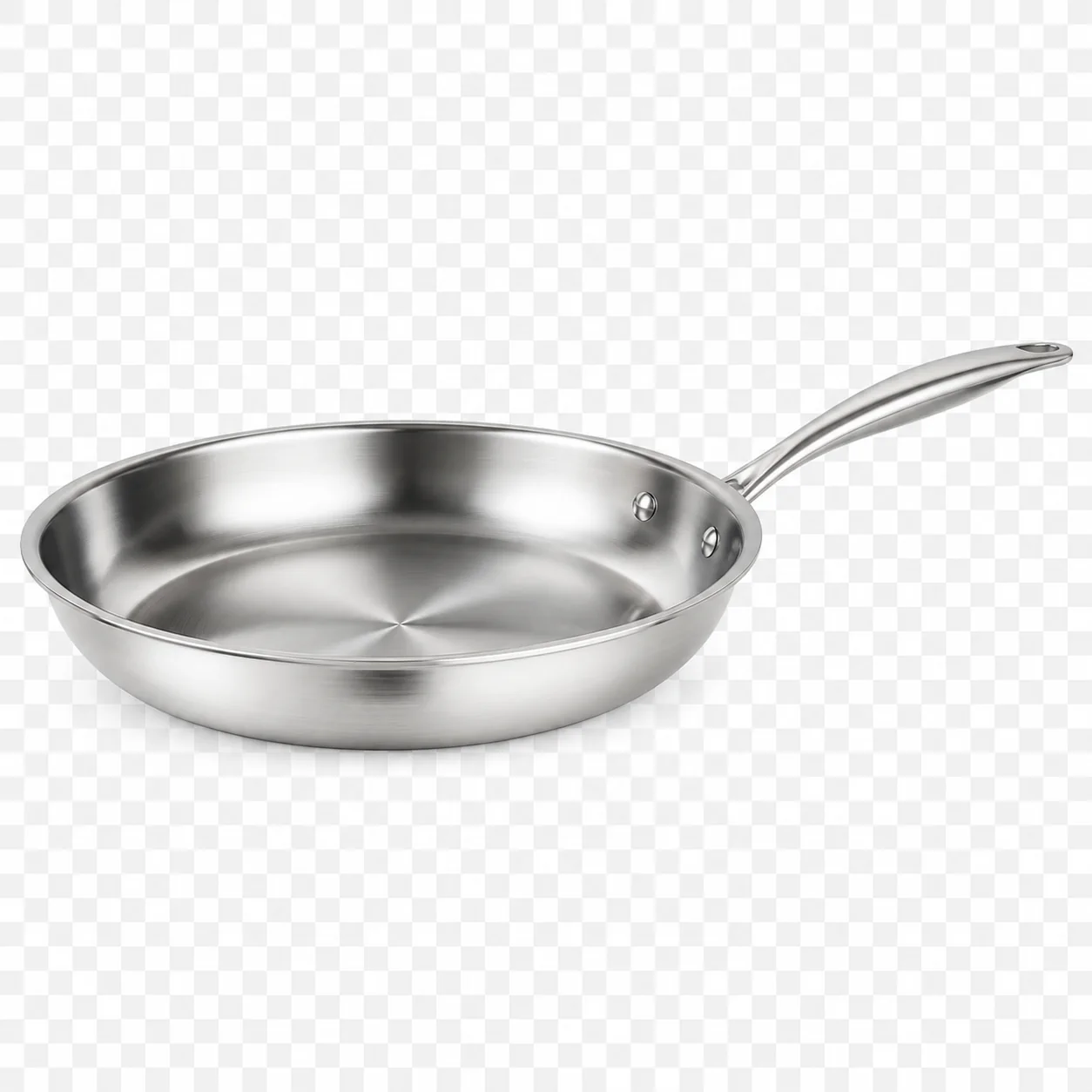
| Release without seasoning | Limited; technique and oil matter | Limited before seasoning | Strong initial release | Designed for immediate release without seasoning |
| Surface durability | No nonstick coating to wear away | Hardened surface; seasoning changes over time | Depends on coating grade, thickness and use | Raised dots are designed to protect the ceramic layer |
| High-heat use | Generally suitable | Generally suitable | Must follow coating temperature limits | Supplier reports a 600°F / 315°C, 30-minute oven test |
| Fluoropolymer coating | None | None | Typically present | Supplier describes the G8 sol-gel coating as PTFE-free |
| User care burden | Moderate | Higher if seasoning is required | Low, but utensils and heat must be controlled | Designed for simple nonstick use; care instructions still apply |
| Best fit | Professional searing and long-life cookware | Consumers comfortable with seasoning | Convenience-led mass-market cookware | Brands seeking a ceramic, low-seasoning alternative |
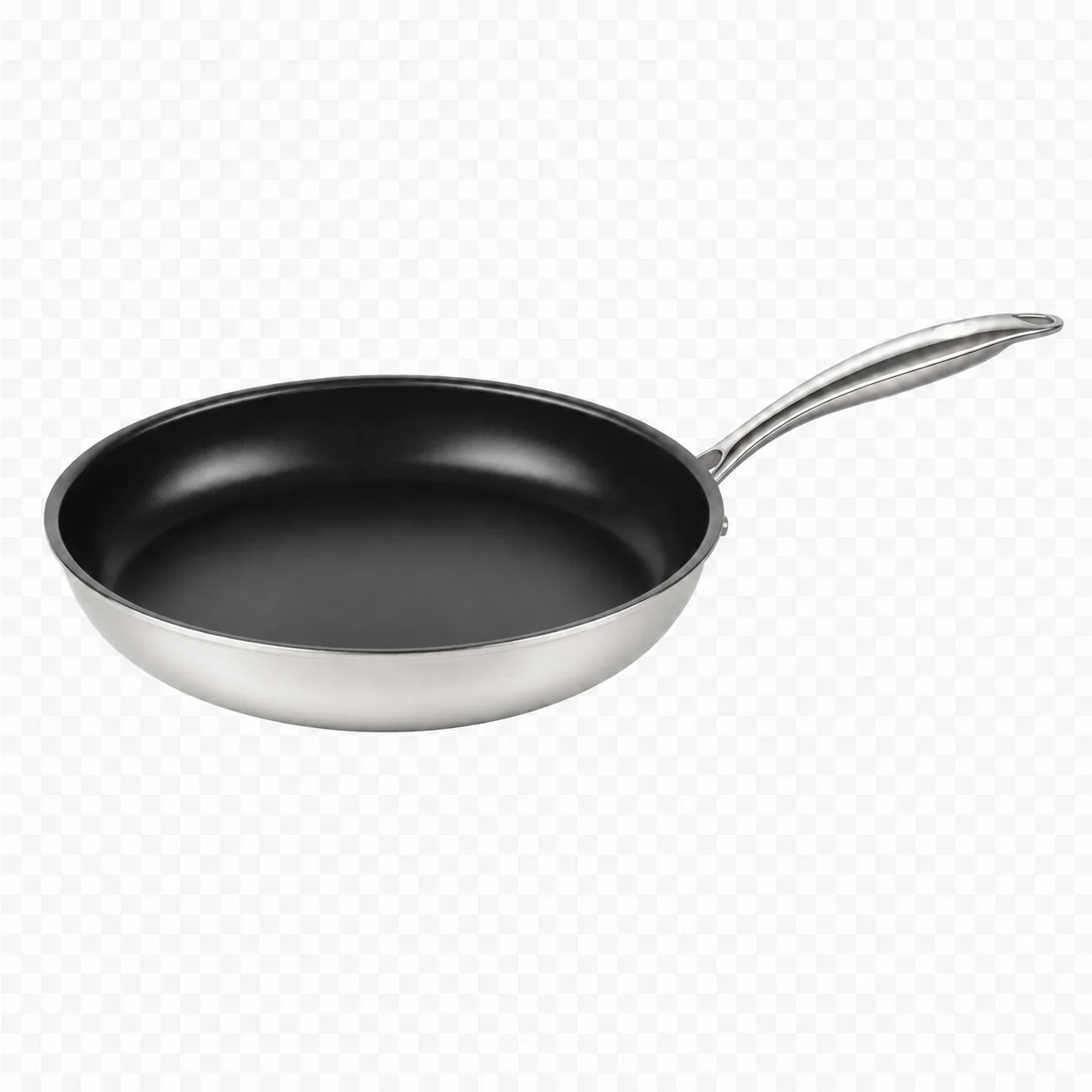
What Nitriding Actually Does—and What It Does Not Do
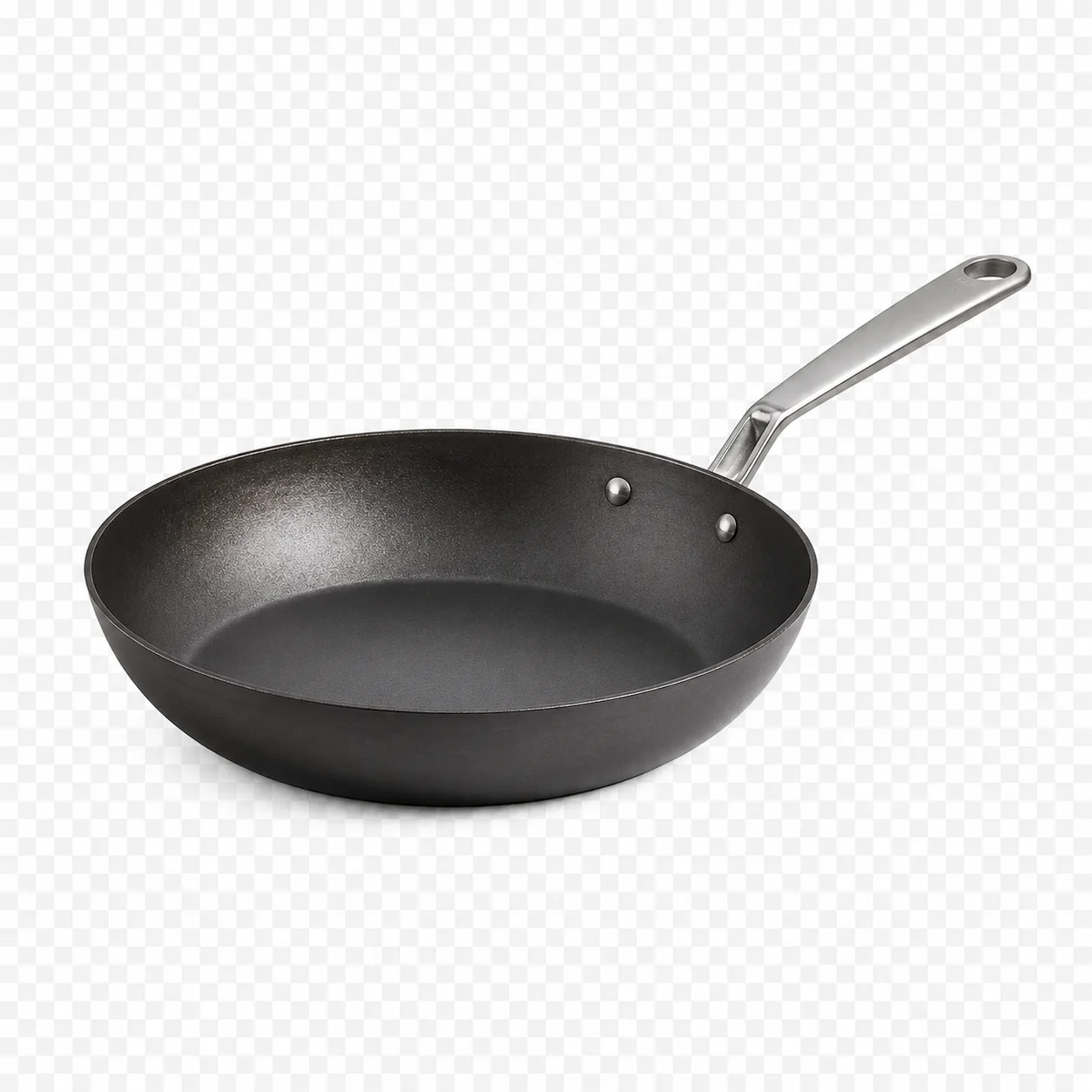
Nitriding is a surface-hardening process. It can improve wear resistance and help a steel pan resist corrosion. Those are meaningful benefits, especially for cookware expected to tolerate metal utensils, repeated heating, and demanding kitchens.
But hardness is not the same as food release. A nitrided surface does not automatically become nonstick. In most products, the consumer still needs oil, heat control, and repeated seasoning. When use and care instructions are unclear, the experience can vary from one household to another.
For a buyer, the key question is not “Is the steel nitrided?” It is “What release performance can the finished pan demonstrate without requiring expert seasoning?”
This distinction matters for brands serving first-time cookware buyers. A product that works well only after careful seasoning may generate unnecessary support questions or returns if it is marketed as effortless nonstick cookware.
Where PTFE Nonstick Still Fits
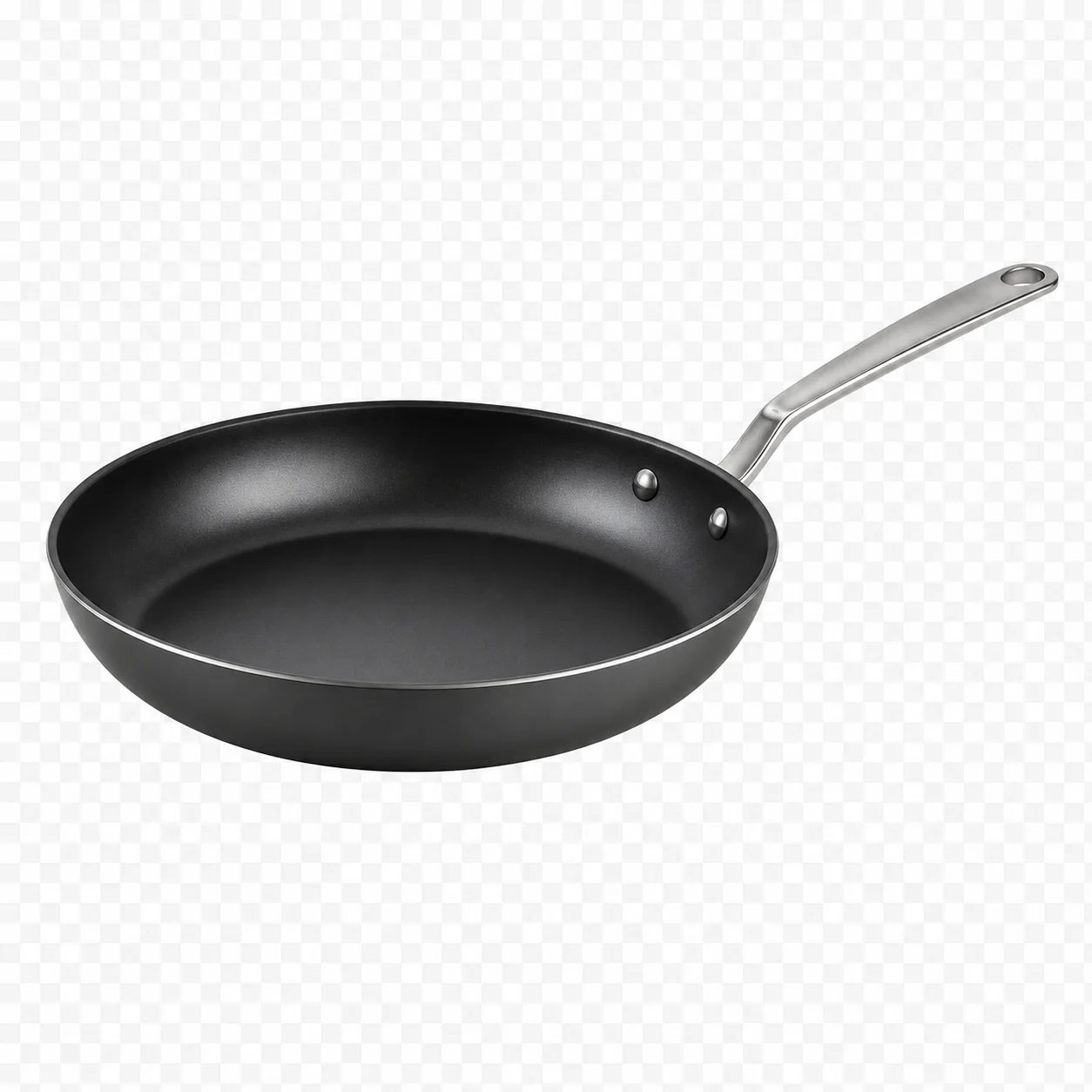
Conventional PTFE cookware remains popular because it provides dependable release at a competitive price. It is familiar to consumers and effective for eggs, fish, pancakes, and low-fat cooking.
The sourcing challenge is specification control. Brands need to know the coating system, application process, cure conditions, recommended temperature range, substrate preparation, abrasion performance, and documentation available for each sales market. Vague claims such as “Teflon-free,” “PFOA-free,” or “eco-friendly” should never replace a complete material declaration.
For current regulatory context, consult the U.S. EPA PFAS information hub, the FDA guidance on authorized PFAS uses in food-contact applications, and ECHA’s PFAS topic and restriction information. Requirements and authorizations vary by substance, application, supplier, and destination market.
PTFE is therefore not automatically the wrong choice. It is a different product proposition—one that requires transparent specifications, clear heat guidance, and honest expectations about coating wear.
How the Micro-Dot Ceramic Structure Changes the Design
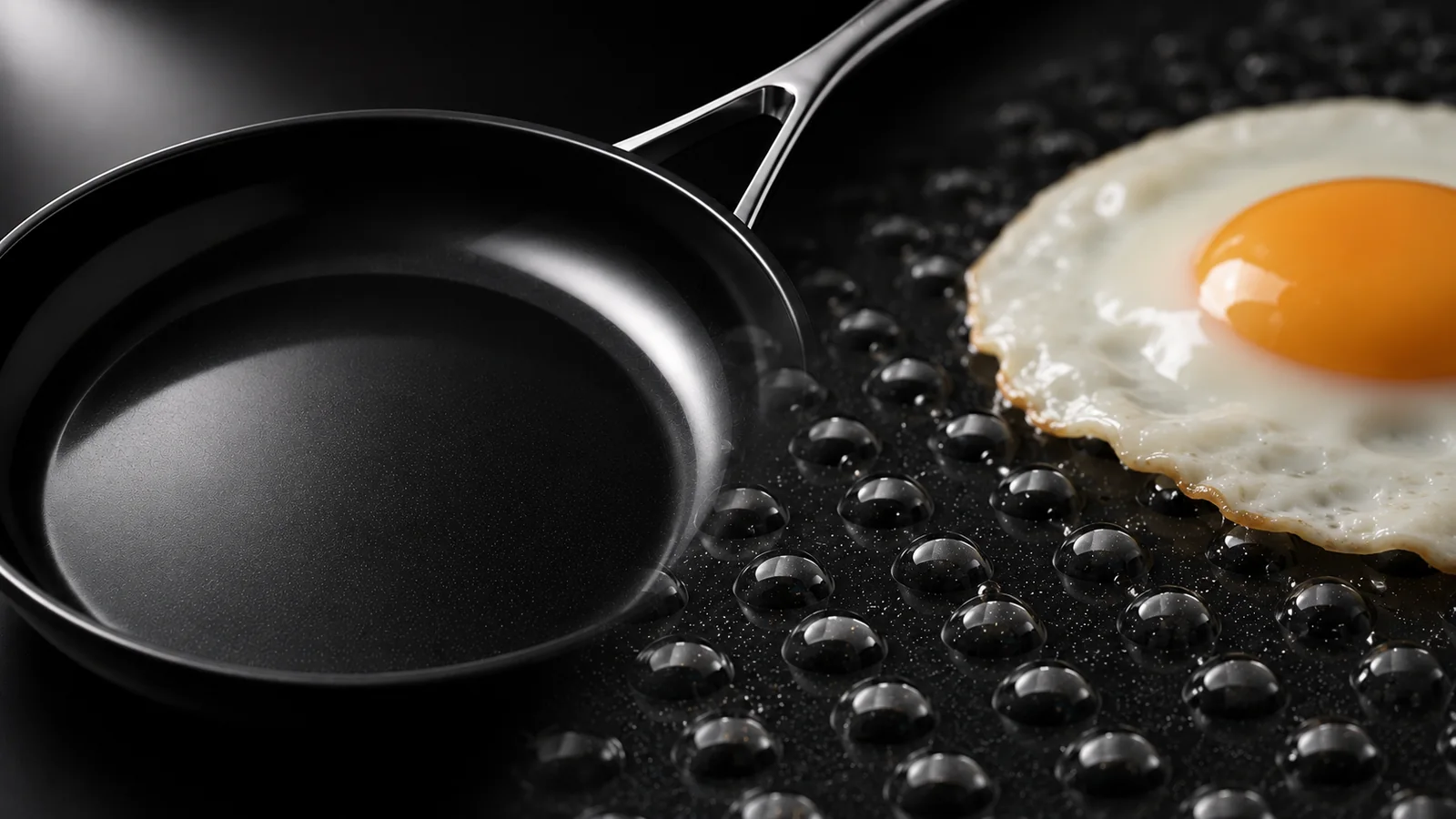
Shangwey’s supplied materials describe a 0.4 mm precision micro-dot matrix applied above a sol-gel ceramic coating. The concept combines two functions: the ceramic layer provides release, while the raised dots reduce direct contact between food, utensils, and the coating below.
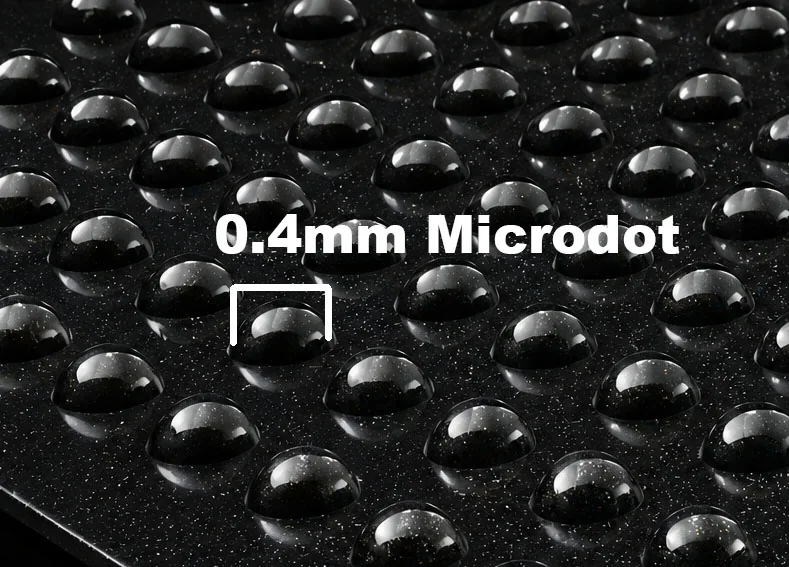
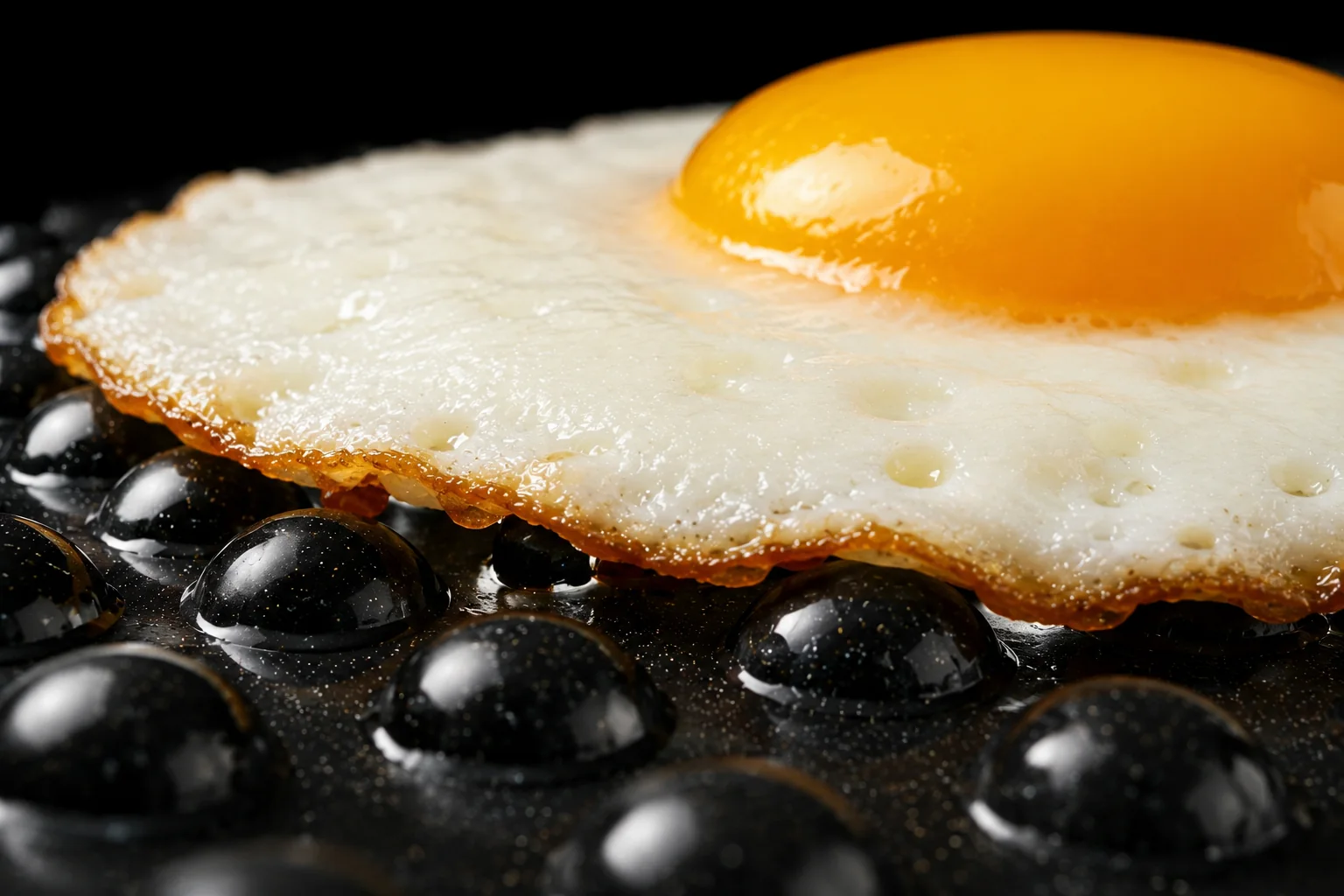
This is an engineering approach rather than a marketing color change. If the geometry, adhesion, and coating process remain consistent in mass production, the protected surface may help slow the kind of utensil abrasion that shortens the useful life of conventional smooth coatings.
The supplied document identifies the structure as SiO₂ Micro-Dot Matrix Technology and references Chinese patent number ZL 2025 2 0824566.X. Buyers should verify the patent scope and obtain current documentation before reproducing the number on packaging or sales materials.
Durability Is More Than a Pencil-Hardness Number
Hardness, adhesion, corrosion resistance, wet abrasion, nonstick release, and thermal cycling evaluate different failure modes. A credible cookware quality-control program should not rely on one result alone.
According to the supplied test materials, the G8 ceramic system reached 9H pencil hardness and was subjected to a 600,000-cycle wet abrasion test using a steel wire ball under a stated 1 kgf load. The materials also show adhesion, corrosion, preheated nonstick, and high-temperature evaluations.
Thermal expansion deserves equal attention
A coated metal pan is a system: substrate, bonding layer, coating, and production temperatures must work together. When the metal body and coating expand differently, repeated heating can create micro-cracks or weaken adhesion.
The supplied materials state that Shangwey uses a staged sintering process intended to align the coating with a five-layer metal construction. They report a 600°F (315°C) oven exposure for 30 minutes followed by cooling, with no observed micro-cracks and retained release performance. This is useful development evidence, but buyers should confirm sample size, test standard, laboratory conditions, and repeatability.
Performance Test Gallery
The six individual images below replace the former combined “Performance Test” poster. Test methods and result labels are transcribed from the supplied performance panel; buyers should verify them against the latest signed laboratory reports.
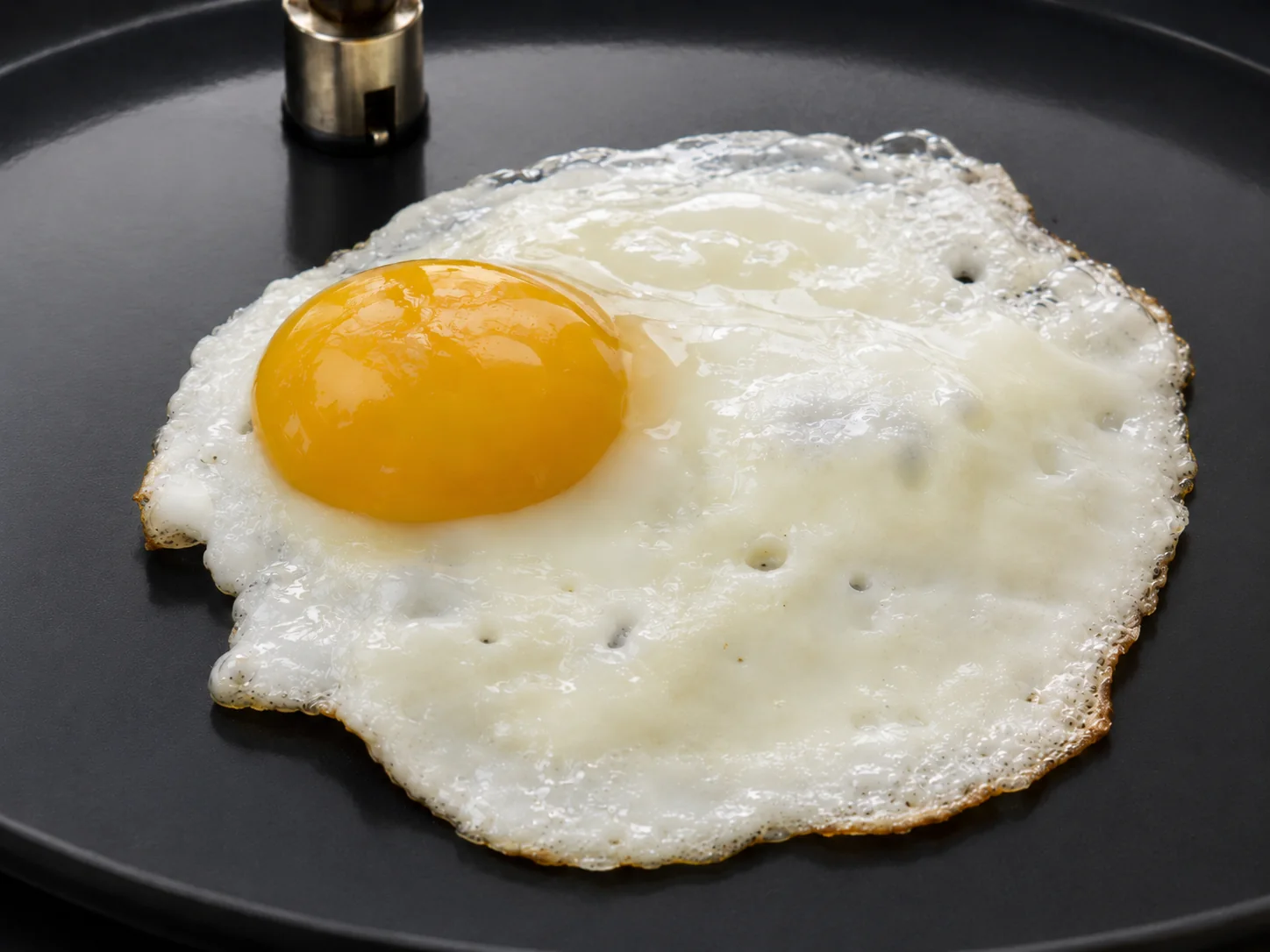
After cleaning a specimen with neutral detergent, heat it at 300°C for 30 minutes, then cool it at room temperature. Fry 10 eggs in a row at 180–190°C without oil and evaluate this as one cycle. Each egg is fried for 100 seconds. Count the cycles until a fried egg completely sticks to the coated surface twice in a row.
Depending on generation type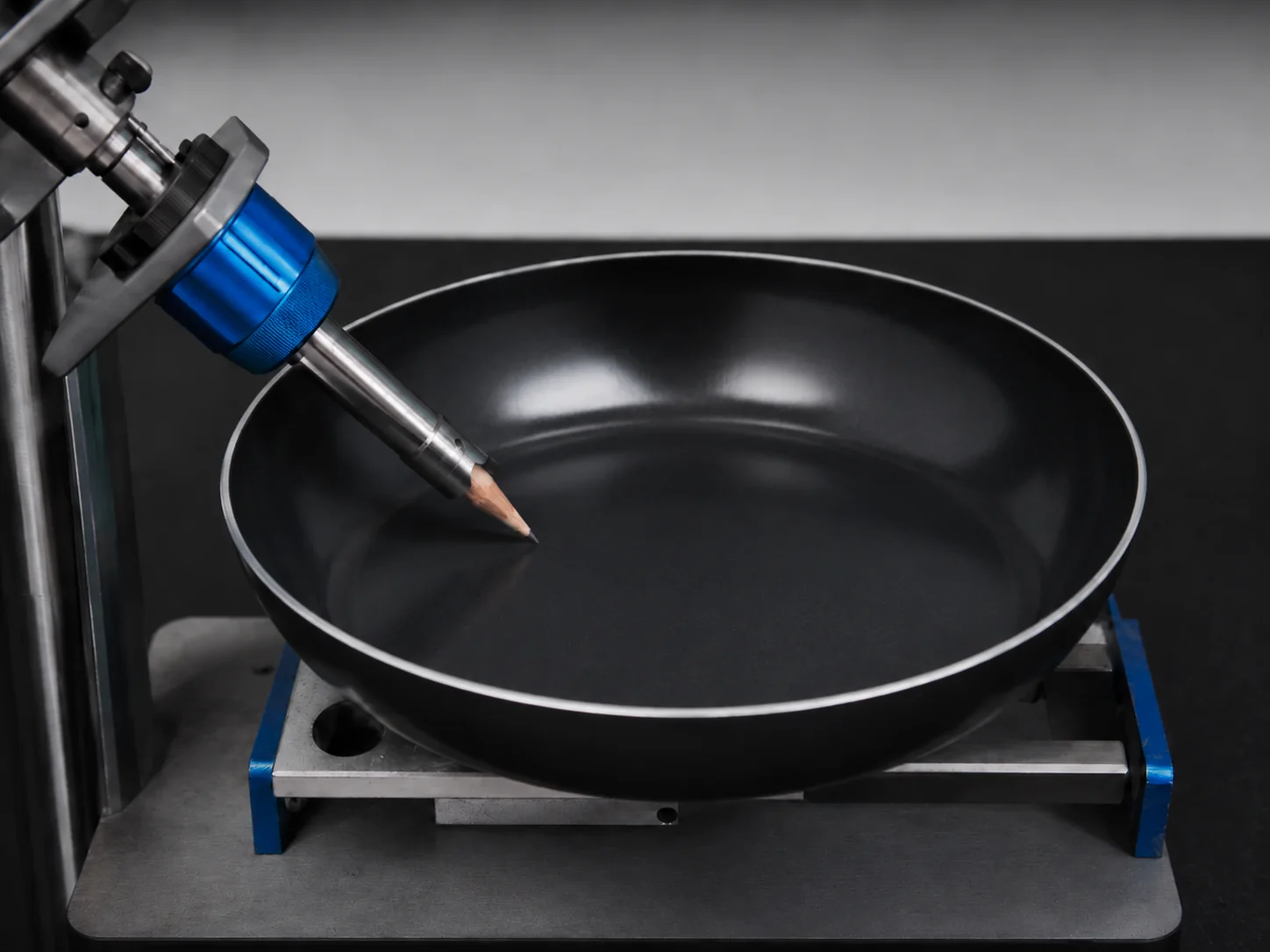
Draw a 100 mm line five times with a 1 kgf load at a 45° angle, then visually check for scratches or coating peel-off.
Above 9H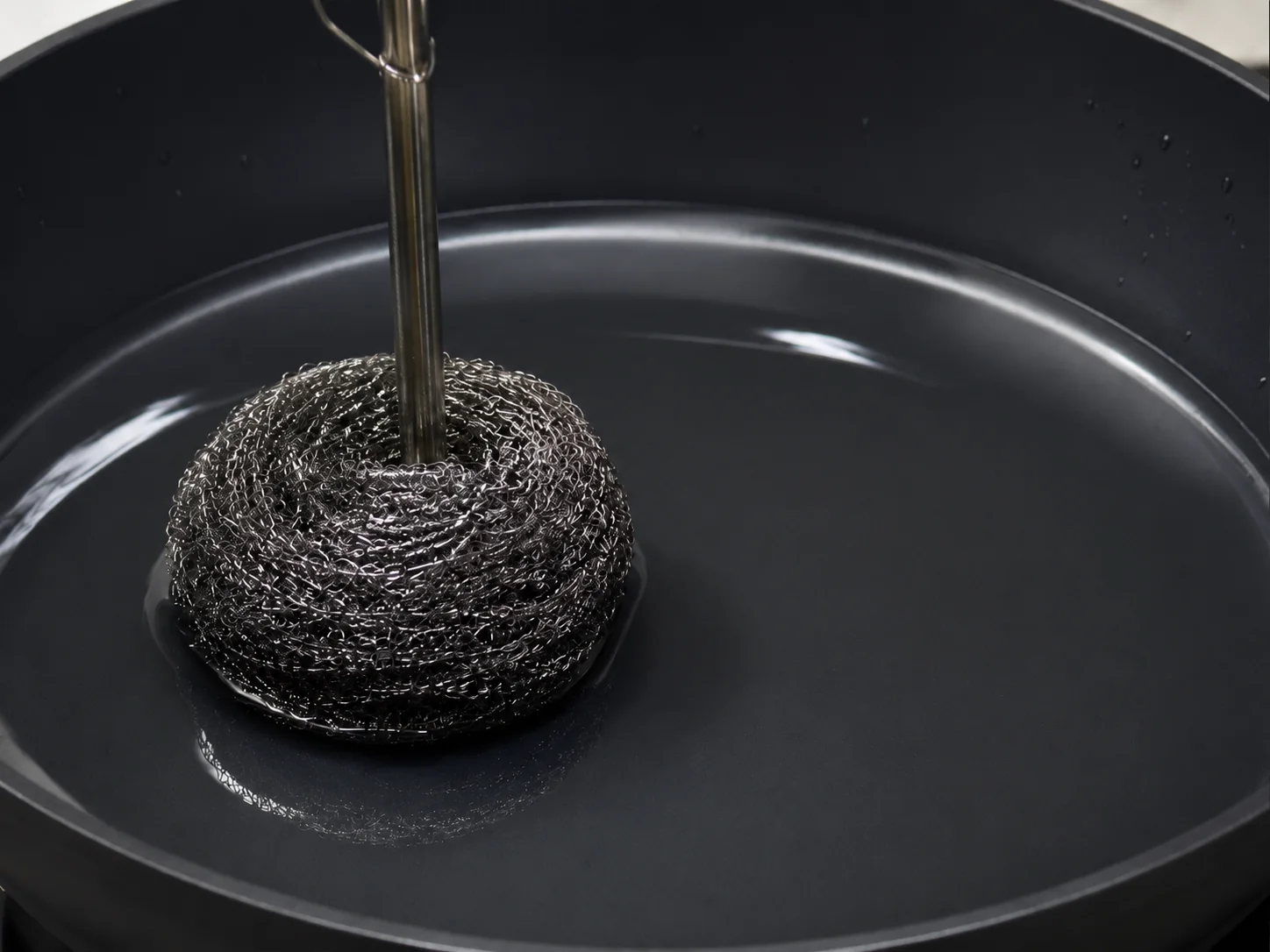
Place a stainless steel scrubber (MSBL-45G) on the dry film surface in a Taber abrasion tester and add 0.5% detergent water. Run back-and-forth abrasion cycles with a 1 kg load at 60 rpm, replacing the worn scrubber every 50,000 cycles. The substrate should not be exposed by coating peel-off after the specified cycles.
Depending on coating type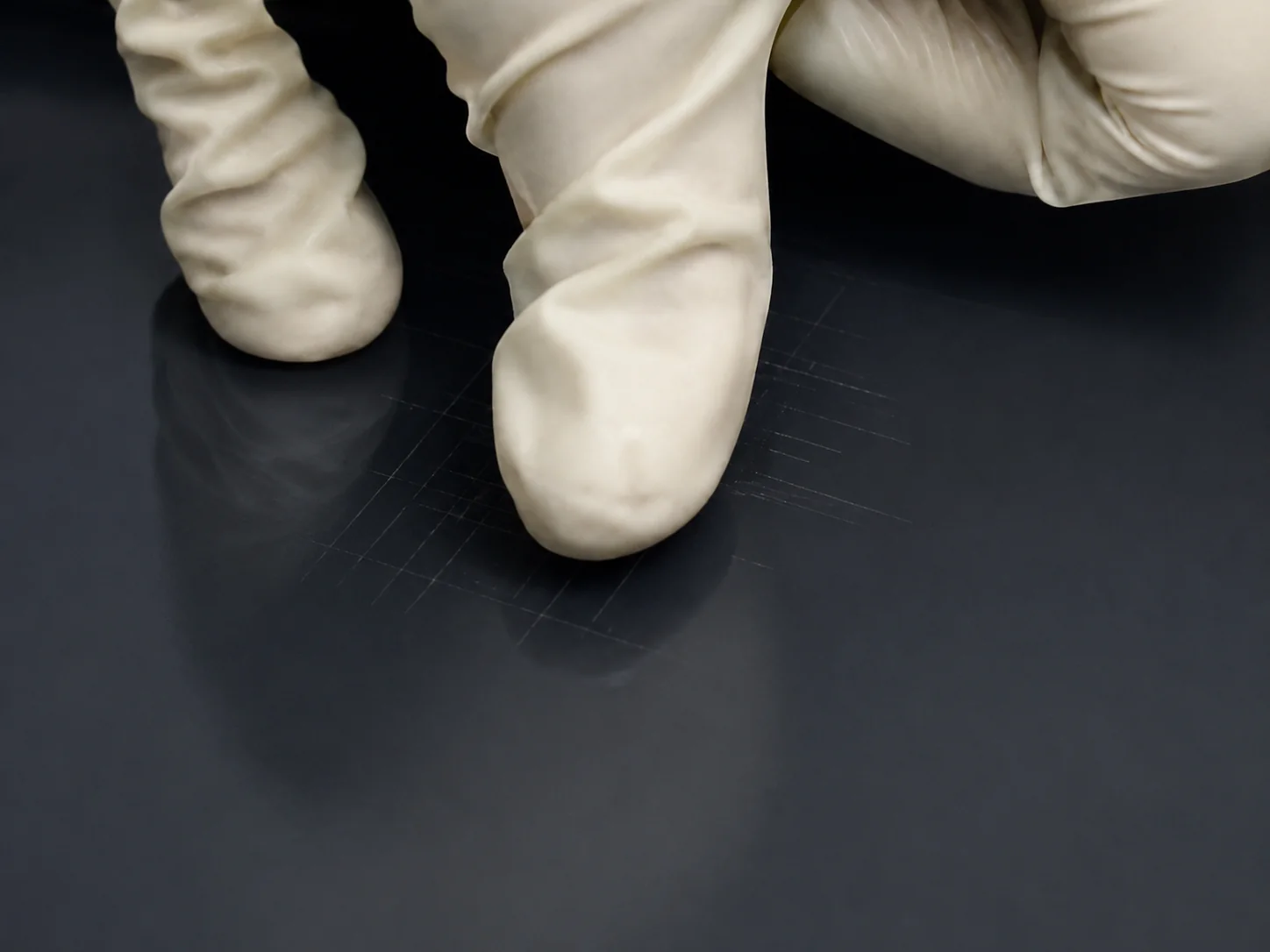
Make 25 blocks with 2 mm-wide cuts using a cross-cut guide, then check coating peel-off with adhesive tape.
25 / 25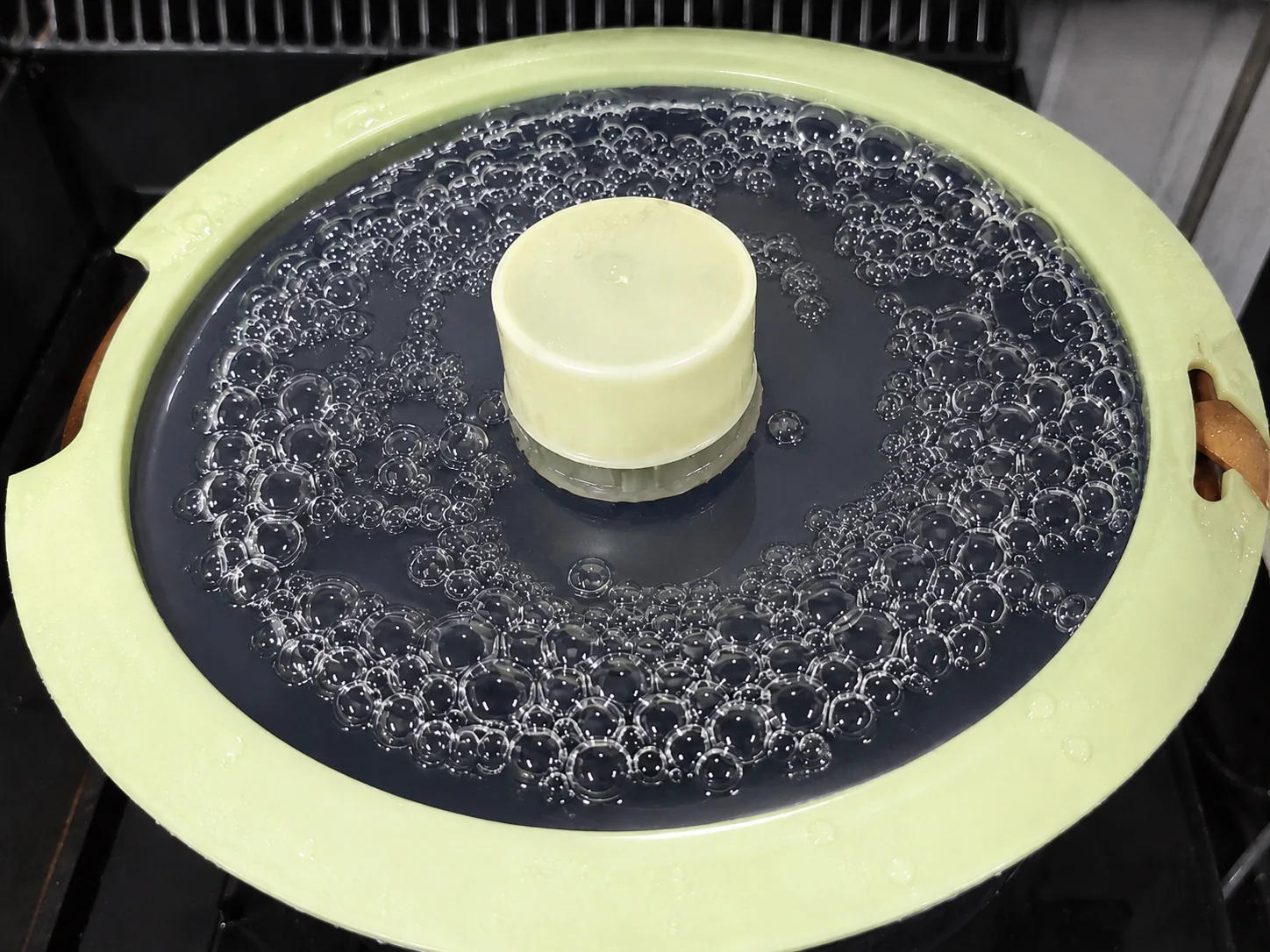
Boil 10% salt water for 8 hours, then leave the specimen for 16 hours at room temperature as one cycle. Evaluate corrosion after three cycles.
Clear
Boil 10% salt water at 95±2°C for 20 hours, then inspect the specimen for corrosion.
ClearA Better Buyer Checklist for Nonstick Cookware
Before approving a pan for retail, ask the manufacturer to connect every claim to a specification, report, or production-control step.
- Confirm the complete material declaration. Identify the substrate, bonding layers, coating chemistry, pigments, and any fluoropolymer content.
- Request market-specific compliance documents. Check that reports are current, issued for the correct SKU and material system, and relevant to the destination market.
- Review test methods, not just headline numbers. Ask about load, abrasive material, temperature, cycle definition, sample quantity, and pass/fail criteria.
- Test real cooking behavior. Evaluate eggs, protein, sauces, preheating, cleaning, handle temperature, balance, and induction response.
- Compare samples with production goods. Define acceptable limits for coating thickness, gloss, color, dot geometry, flatness, and adhesion, then confirm how the manufacturing process controls those limits.
- Write realistic care instructions. Even durable ceramic cookware benefits from sensible heat, utensils, cleaning, and storage guidance.
Frequently Asked Questions
Is nitrided steel naturally nonstick?
No. Nitriding primarily improves surface hardness and corrosion resistance. Food release still depends on oil, temperature control, surface finish, and often seasoning.
Is ceramic cookware always PTFE-free?
Not necessarily. “Ceramic” is used broadly in the market. Buyers should request a complete coating declaration and test documentation for the exact product rather than relying on the product name alone.
What is the purpose of the raised micro-dot surface?
The raised dots are designed to reduce food contact area and shield the coating from direct utensil friction. Actual performance depends on dot geometry, bonding, coating quality, and manufacturing consistency.
Does a 600,000-cycle abrasion result guarantee a fixed service life?
No. Laboratory cycles help compare systems under controlled conditions, but home and commercial use vary. Service-life claims need a defined test method, care conditions, and appropriate qualification.
What should an OEM cookware buyer test first?
Start with material verification, release performance, adhesion, abrasion, corrosion, thermal cycling, induction compatibility, handle temperature, and repeatability across production samples.